Robinhood AI Agents: How Autonomous Trading Works
Robinhood Agents can research markets, build strategies, and place trades. Learn how the controls, costs, risks, and coming Loops feature work.
88 Labs AI
Editorial Team
The short answer
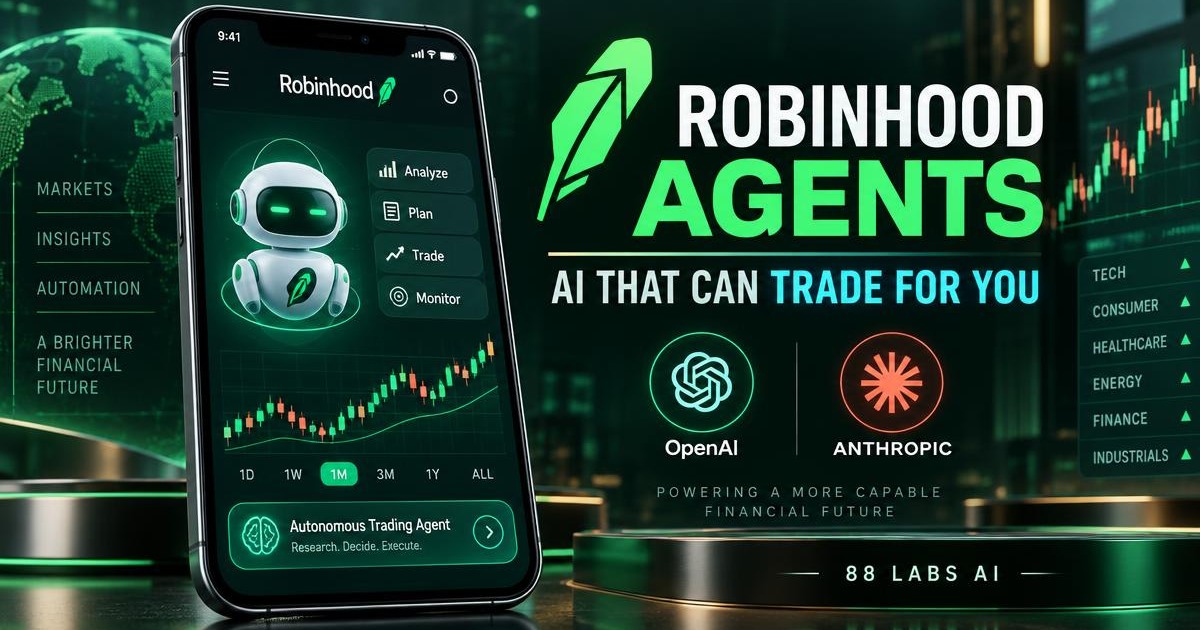
Robinhood Agents brings AI-powered research and trading directly into the Robinhood mobile app. Customers can name an agent, choose an available AI model, fund a separate Agentic account, ask questions in everyday language, and let the agent propose or place eligible trades.
The launch matters because it moves agentic trading from a technical integration into a mainstream consumer product. But it does not remove investment risk. Robinhood says trade approvals are on by default, yet customers can turn them off. Its disclosures also make clear that customers remain responsible for the trades their agents place and could lose their entire investment.
Robinhood announced the product at HOOD Summit 2026 in Houston on September 29. It is beginning to roll out to eligible U.S. customers, so access may not appear in every account immediately.
What are Robinhood Agents?
Robinhood Agents are personalized AI trading agents built into Robinhood. According to Robinhood's announcement, an agent can analyze markets, develop strategies, and trade on a customer's behalf. The company positions the feature as an easier alternative to connecting an outside agent through technical tools.
Setup happens in the mobile app:
1. Open the Agents area and name the agent.
2. Open a dedicated Agentic account.
3. Review the trade-approval control.
4. Choose an available AI model.
5. Fund the Agentic account and begin chatting.
Robinhood's setup guide says the full experience is currently available only in the mobile app. Web access to Agentic accounts may be limited, and a customer can currently create one built-in agent.
What can a Robinhood AI agent do?
The agent combines conversation, market data, portfolio context, tools, and trading permissions. Robinhood says customers can use it to:
This is more than a chatbot that summarizes headlines. Once the customer grants the necessary authority, the agent can move from analysis to action inside a dedicated trading account.
Robinhood says more than 150,000 customers opened agentic trading accounts following its earlier external-agent launch, with agents using Robinhood tools almost 30 million times per day. Those figures measure adoption and tool activity—not investment returns.
Trade approvals are on by default
Trade approvals are the most important control to understand. With approvals on, the agent proposes a trade and the customer must review and place it manually. With approvals off, the agent can place eligible trades without confirmation for each order.
Robinhood's trading guide says approvals are enabled by default for built-in Robinhood Agents. Customers can change that setting later. Certain transactions may still require confirmation, and product eligibility can vary.
The safer starting point is straightforward: keep approvals on, use a small separately funded account, and review the agent's reasoning and order details before allowing broader autonomy.
What are Robinhood Agent Loops?
Agent Loops are a coming feature for turning a strategy into a repeated instruction. Robinhood describes Loops as a way for an agent to research or trade continuously or on a schedule.
For example, a Loop might scan a watchlist every morning, monitor a portfolio threshold, or rerun a defined research process. Because the instruction persists, the agent may continue operating when the customer is not actively using the app.
Loops were announced as coming soon, not as a universally available feature. Robinhood also warns that automated strategies can move quickly and may be difficult to monitor or stop in real time. Turning off a routine cannot undo trades already executed.
Why the separate Agentic account matters
Robinhood requires a dedicated Agentic account rather than giving the agent unrestricted trading access to a customer's primary investing account. The customer chooses how much money to fund into that separate account, making the boundary visible and easier to monitor.
That separation can limit the amount directly available to the agent, but it is not a guarantee against loss. A poorly designed instruction, unexpected market movement, inaccurate model output, or misunderstood request can still produce damaging trades inside the funded account.
Account separation is therefore a guardrail—not a substitute for strategy testing, position limits, or human review.
What are Agent Apps?
Agent Apps are optional subscriptions that expand what a Robinhood-hosted agent can access. Robinhood says they can include third-party datasets, specialized skills, and additional tools.
According to the Agent Apps guide, most apps charge a monthly fee and may include a one-month trial. App subscriptions are separate from the prepaid token balance used for conversations with the agent.
This creates a marketplace layer around the agent. Instead of every capability being built by Robinhood, specialist providers can package financial data or analysis tools for an agent to use inside the app.
How much do Robinhood Agents cost?
Robinhood says conversations with a built-in agent use tokens from a separate prepaid balance. Customers receive a starting balance and can buy more. Cost, speed, and reasoning capability can vary by the model selected.
Third-party Agent Apps may add monthly subscription fees. Trading, account, market-data, options, crypto, and other charges can also depend on the products used. Robinhood has not presented the feature as unlimited free AI trading.
Before relying on an agent regularly, customers should understand both direct fees and indirect costs such as token usage, subscription renewals, spreads, interest, or losses from execution.
Robinhood Agents versus external agents through MCP
Robinhood's earlier agentic trading product lets technical users connect an external AI agent through Model Context Protocol (MCP). MCP is an open standard that allows an AI system to use tools in another service.
The new built-in product removes much of that setup. Robinhood connects the hosted agent to its trading tools and starter skills during onboarding. External agents remain an option for users who want more control over their agent environment.
This distinction matters for businesses and advanced users:
| Approach | Best fit | Main trade-off |
|---|---|---|
| Robinhood Agents | People who want a guided, in-app experience | Easier setup but less control over the surrounding agent environment |
| External agent via Robinhood MCP | Technical users building custom workflows | More flexibility but more setup, testing, and security responsibility |
For a broader explanation of the connection layer, read our guide to MCP Apps and interactive agent tools.
The risks customers should understand
Robinhood's own disclosures are direct: agentic trading can involve the loss of an entire investment, and AI-driven strategies may behave poorly under some market conditions.
Customers should consider at least six risks:
1. The agent can misunderstand instructions
Natural-language requests can be ambiguous. A strategy that sounds clear in conversation may omit position size, timing, liquidity, tax, or stop conditions.
2. Market data can change faster than the reasoning
An answer can become stale before an order executes. Volatile markets make timing and execution quality more consequential.
3. Autonomous routines can repeat mistakes
A one-time mistake is harmful. A recurring Loop can repeat a flawed assumption until it is detected and stopped.
4. Third-party models and apps add dependencies
The experience can rely on outside AI models, datasets, and tools. Their availability, pricing, privacy terms, and behavior can change.
5. Customers retain responsibility
Robinhood's Agents Agreement says Robinhood Labs provides the technology layer and is not an investment adviser. Brokerage and crypto transactions are handled by the applicable regulated Robinhood affiliates. The customer remains responsible for investment decisions made through the agent.
6. An AI agent can encounter untrusted information
An agent that researches external content may encounter misleading data or instructions designed to manipulate automated systems. Our guide to securing AI agents against prompt injection explains why permissions, trusted sources, and approval gates matter.
A practical safety checklist
Before allowing any AI agent to place trades:
These controls do not make an automated strategy safe or profitable. They make its behavior easier to constrain, inspect, and stop.
What Robinhood Agents mean for business
The bigger story extends beyond retail investing. Robinhood is showing how agent products may be packaged for mainstream use:
That pattern can apply to sales, finance operations, customer service, procurement, and other business workflows. The lesson is not that every business should automate high-stakes decisions. It is that useful agents need clear permissions, bounded resources, observable activity, and an accountable human owner.
Teams considering action-taking agents should begin with our AI Agents 101 guide and evaluate governance before connecting an agent to sensitive systems.
The 88 Labs AI perspective
Robinhood Agents is an important shift because it makes an action-taking financial agent feel like a normal app feature. The separate account, default approvals, and visible activity history are sensible design choices.
The difficult part begins after setup. A polished interface cannot guarantee that an AI model has interpreted a strategy correctly or that the strategy will work in changing markets. The coming Loops feature increases convenience and operational risk at the same time.
Our view is that autonomy should be earned gradually. Start with research, then proposed actions, then narrowly bounded execution. Expand permissions only after the system has shown consistent behavior under real conditions. In financial workflows, boring controls are more valuable than impressive demos.
FAQ
What are Robinhood Agents?
Robinhood Agents are AI trading agents built into the Robinhood mobile app. They can research markets, analyze a portfolio, develop strategies, and place eligible trades through a dedicated Agentic account.
Can Robinhood's AI agent trade without my approval?
Yes, if you turn trade approvals off. Approvals are on by default for built-in Robinhood Agents, which means you review proposed trades before placing them.
Are Robinhood Agents available now?
Robinhood says the product is beginning to roll out to eligible U.S. customers. Availability may arrive gradually, and the full experience is currently mobile-app only.
What are Robinhood Agent Loops?
Loops are a coming feature that will let an agent repeat a strategy continuously or on a schedule. They are intended for persistent research and trading routines and were not universally available at announcement.
Does Robinhood guarantee trades made by an AI agent?
No. Robinhood says customers are responsible for trades placed through their agents. Agentic trading can result in significant losses, including the loss of the full amount invested.
Can an AI agent access my main Robinhood balance?
Built-in agents trade through a dedicated Agentic account that the customer funds separately. This creates a boundary around the trading capital available to the agent.
What is Robinhood's Trading MCP?
Robinhood's Trading MCP lets an external AI agent connect to Robinhood tools for portfolio information and eligible trading actions. It is the more technical alternative to using a built-in Robinhood Agent.
Is Robinhood Agents financial advice?
No. Robinhood Labs says it provides the agent technology and is not an investment adviser. Customers should independently evaluate any strategy and understand the risks before placing or authorizing trades.
Sources
This article is for educational purposes only and is not financial, investment, legal, or tax advice.
Ready to see this in action?
Get a free, personalized demo of an AI agent built for YOUR business.
Get Your Free Demo