Best AI Agent for Business: Grok, Hermes, Muse or Instinct?
Compare Grok Bot, Hermes Agent, Muse, and Instinct by business use case, setup, control, privacy, and access to choose the right AI agent.
88 Labs AI
Editorial Team
The short answer
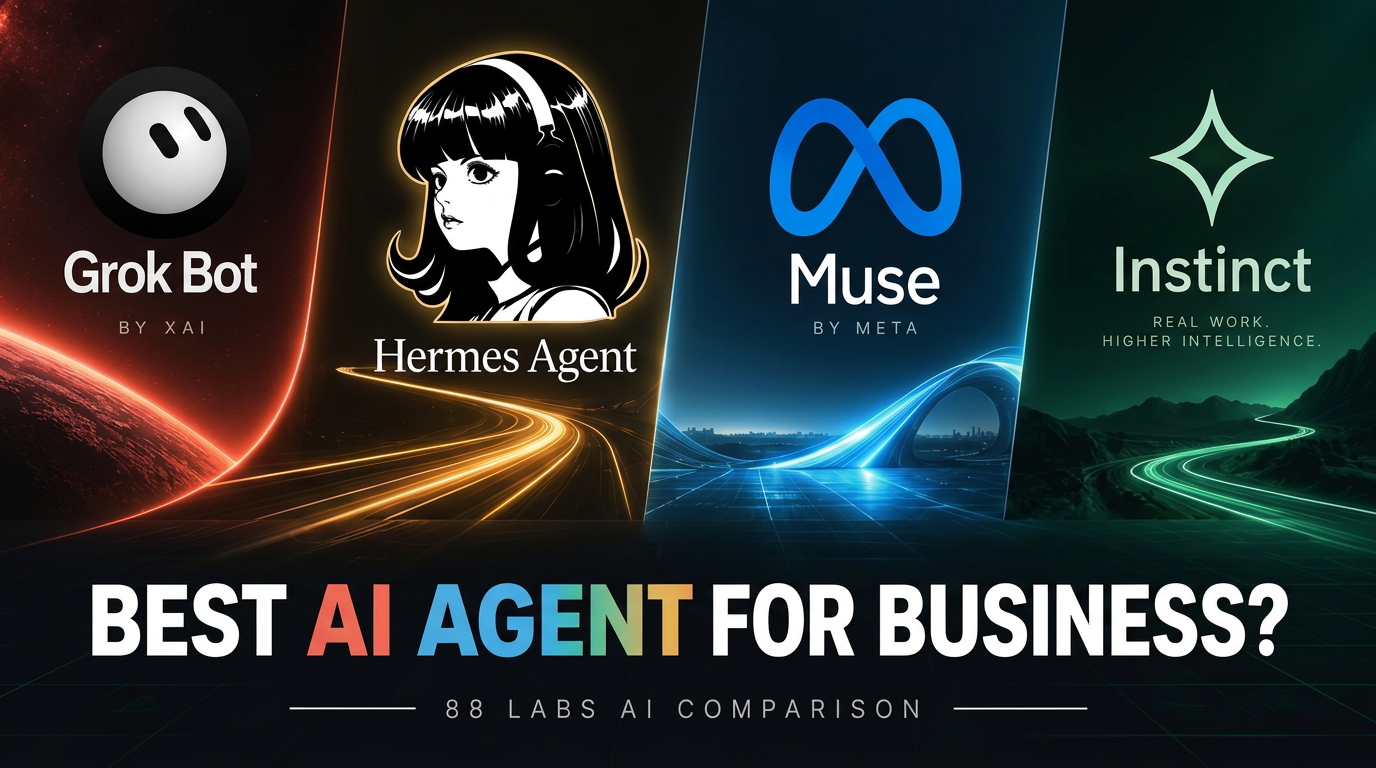
There is no single best AI agent for every business. The right choice depends on whether you need a reliable cloud worker, a customizable self-hosted system, an approachable personal assistant, or a concierge that can complete real-world errands.
Our practical view is simple: Muse is easy to use for personal tasks, Grok Bot is easier to set up for business purposes, and Hermes is the power-user option that requires more technical knowledge and discipline.
Four AI agents at a glance
Grok Bot — best for: reliable, repeatable business routines and background execution. It runs on xAI's models and gives Bots browser, filesystem, and terminal access on a persistent cloud computer.
Hermes Agent — best for: high-control automation, subagents, custom memory, model choice, and deep integrations. It is open source and can run on your own laptop, a private server, or supported cloud sandboxes.
Muse — best for: approachable personal task management through Meta's ecosystem, including WhatsApp. Meta describes Muse as a proactive personal AI agent with its own secure virtual machine.
Instinct — best for: resourceful personal-assistant tasks completed through text or calls, including reservations, inbox work, account connections, and finding savings. It is currently limited to private access.
1. Grok Bot: the easiest business daily driver
Grok Bot is built around named AI teammates rather than a blank chat box or a visual workflow builder. A Bot can use a browser, filesystem, and terminal, learn a routine from a demonstration, save it as a skill, and run that skill on a schedule.
That makes it a strong fit for the unglamorous work businesses need every day:
What Grok Bot gets right
The setup model is easy to understand: tell a Bot what to do, show it the process when needed, and refine the resulting skill. For a business owner who wants useful automation without becoming an infrastructure engineer, that is compelling.
xAI also supplies the cloud environment. There is no Mac Mini to maintain and no private server to patch. That convenience is why we see Grok Bot as the easiest of these four to set up for business use.
The Grok Bot trade-offs
Convenience means accepting xAI's hosted ecosystem and its usage rules. One important correction to common descriptions: each Bot does not receive an isolated computer. All Bots on one user account share one cloud computer. Their screens are separate work surfaces, not security boundaries. Credentials or files placed there may be usable by another Bot on the same account.
xAI bundles Bot access with eligible paid plans and separates Bot usage from normal plan quotas, but it has not published a simple per-token Bot price. Businesses should measure actual usage instead of assuming a fixed token-cost advantage or penalty.
If this approach fits your company, see our Grok Bot setup and maintenance service or read the Grok Bot business workflow guide.
2. Hermes Agent: the control-first choice
Hermes Agent from Nous Research is open source. It supports persistent memory, reusable skills, subagents, and messaging connections including Slack, Telegram, Discord, WhatsApp, Signal, email, and the command line.
The biggest difference is deployment freedom. Hermes can run on your own laptop, a small VPS, a private server, or a supported sandbox. It can use models through Nous Portal, OpenRouter, OpenAI, or your own compatible endpoint. That lets a technical team choose different models for different jobs and keep more of the system under its control.
What Hermes gets right
For a team orchestrating several business agents across systems such as Slack, documents, CRM data, and internal knowledge, Hermes offers the most flexible foundation in this comparison.
The Hermes trade-offs
Control creates responsibility. Someone must choose the hosting environment, configure providers, secure credentials, monitor costs, maintain integrations, and troubleshoot failures. Hermes can be inexpensive to self-host, but its true cost includes technical time.
That is why our perspective differs from a simple feature checklist: Hermes is powerful, but it requires more technical knowledge and operational discipline than Grok Bot or Muse. Read our cloud versus self-hosted Hermes analysis before choosing a deployment model.
3. Muse: the approachable personal option
Muse is the official product name for Meta's personal AI agent. Meta positions it as a proactive consumer assistant that can work in its own secure virtual machine, use a browser, manage files and artifacts, set reminders, and continue tasks through WhatsApp.
Muse is not primarily marketed as a business operations platform. Its appeal is familiarity: people already understand messaging, and Meta can place the agent inside tools they use every day.
What Muse gets right
Our view: Muse is the easiest of these four for personal use. It can reduce the friction between having an intention and completing a task without asking someone to learn automation software first.
The Muse trade-offs
Muse is optimized for personal goals and Meta's ecosystem, not for local deployment or deeply customized business-agent infrastructure. Meta has not disclosed a local-hosting option or public token pricing. Teams should not assume it provides the same integration freedom as Hermes or the same business-workflow focus as Grok Bot.
4. Instinct: the proactive concierge
Instinct presents itself as an assistant that uses a phone and computer the way a person would. It works through text and calls and can tackle end-to-end personal tasks such as bookings, reservations, inbox cleanup, account sign-ups, and finding savings.
This is the most concierge-like product in the group. Instead of asking users to build workflows, Instinct emphasizes giving the assistant an outcome and letting it navigate the messy steps between request and result.
What Instinct gets right
The Instinct trade-offs
Instinct is currently available only to a private access group, with a waitlist or member invitation required. Its work can also require sensitive account permissions, so buyers should understand exactly which credentials, messages, and services a task needs before granting access.
Instinct does not publicly describe a self-hosting option, token pricing, or a persistent virtual computer in the same terms as Grok Bot and Muse. Those details should not be assumed until the company documents them.
Which AI agent should your business choose?
Choose Grok Bot when reliability and setup speed matter most
Grok Bot is the clearest choice for a small or midsize business that wants repeatable work running quickly without owning the underlying infrastructure. It is especially strong when the workflow crosses websites and desktop-style tools.
Choose Hermes when control and customization matter most
Hermes is better when you have technical staff, specific security requirements, custom memory needs, or a reason to run particular models on infrastructure you control. The flexibility is real, but so is the setup burden.
Choose Muse for approachable personal assistance
Muse makes the most sense when the goal is making everyday personal tasks easier through a familiar Meta and WhatsApp experience. It is not the strongest choice here for custom business systems.
Choose Instinct for high-touch personal errands
Instinct is worth watching when the desired outcome resembles work delegated to a highly resourceful human assistant. Availability and credential requirements make it harder to recommend as an immediate business standard.
The 88 Labs AI perspective
Feature lists hide the most important buying question: who will own the complexity after the demo?
For most businesses, an agent that employees actually use is better than a theoretically perfect system requiring constant engineering. That makes Grok Bot the most practical starting point in this group for business routines. Its hosted environment and demonstration-based setup reduce the distance between an idea and a working process.
Hermes becomes more attractive as requirements get stricter. If a company needs private infrastructure, custom model routing, specialized memory, or deep cross-agent coordination, its technical investment can buy meaningful control.
Muse and Instinct belong on a different axis. They show how personal agents can become useful by fitting into normal conversation rather than asking users to manage workflows. Muse is the approachable personal choice; Instinct aims for a more proactive concierge experience but is not yet broadly available.
Whatever you choose, start with one narrow routine, limit permissions, assign a human owner, and keep an audit trail. Our guide to securing AI agents explains why those controls matter.
FAQ
What is the best AI agent for business?
Grok Bot is the most practical choice here for businesses that want repeatable cloud-based routines with less technical setup. Hermes Agent is better for technically capable teams that need self-hosting, model choice, and extensive customization.
Is Grok Bot easier to set up than Hermes Agent?
Yes for most nontechnical business users. Grok Bot provides the hosted cloud environment and learns workflows through instructions and demonstrations. Hermes gives teams more control, but they must choose, configure, secure, and maintain more of the system themselves.
Can Hermes Agent run locally?
Yes. Hermes Agent is open source and can run on your own laptop, a private server, a small VPS, or supported cloud sandboxes. It can also connect to several model providers or a compatible endpoint you control.
Is Muse designed for businesses?
Meta positions Muse as a personal AI agent rather than a dedicated business-operations platform. It can help with personal goals, reminders, files, and browser tasks, but public materials do not describe the same business customization and deployment options offered by Grok Bot or Hermes.
Is Instinct available to everyone?
No. Instinct's official site says it is currently available to a private access group. New users can join the waitlist or seek an invitation from an existing member.
Does every Grok Bot have its own computer?
No. xAI says all Bots under one user account share one cloud computer. Separate Bot screens are work surfaces, not security boundaries, so credentials and files should be managed with that shared environment in mind.
Bottom line
For a typical business that wants an AI worker running useful routines soon, start with Grok Bot. For a technical organization that values ownership and customization over convenience, choose Hermes Agent. For personal assistance, Muse is the easier mainstream entry point, while Instinct is the more concierge-like option to watch as access expands.
Ready to see this in action?
Get a free, personalized demo of an AI agent built for YOUR business.
Get Your Free Demo