OpenClaw vs Hermes Agent: Which Open-Source AI Agent Framework Wins in 2026?
A head-to-head comparison of OpenClaw (TypeScript, 359K stars) and NousResearch's Hermes Agent (Python, 95K stars) — architecture, learning loops, security, and which one to deploy.
88 Labs AI
Editorial Team
The open-source AI agent space exploded in early 2026. Two projects now dominate the conversation: OpenClaw, the TypeScript framework that crossed 359,000 GitHub stars, and Hermes Agent, NousResearch's Python-native "agent that grows with you," sitting at ~95,000 stars. They share a goal — autonomous, persistent agents that actually do work — but they get there through very different philosophies.
Here's what's actually different, what's new this month, and which one belongs in your stack.
The state of play (April 2026)
OpenClaw shipped `v2026.4.14` on April 14, a "broad quality release" focused on model-provider improvements, particularly explicit-turn handling for GPT-class models. It follows the much larger `v2026.3.31-beta.1` "Task Brain" update — the first time OpenClaw shipped a real control plane, addressing months of security criticism from researchers like eSentire's Alexander Feick. That release was built by 104 contributors and gave agents the architectural ability to refuse unsafe actions instead of executing them blindly.
Hermes Agent shipped `v0.9.0` (tag `v2026.4.13`) on April 13 — 487 commits, 269 merged PRs, and 167 resolved issues since v0.8.0. The headline feature has been Hermes's defining bet from day one: a built-in learning loop. Hermes creates skills from experience, refines them mid-task, nudges itself to persist knowledge, and searches its own past conversations as context. NousResearch positioned it on their February 25 release as "an autonomous agent that lives on your server, remembers what it learns, and gets more capable the longer it runs."
Same week, two releases, two completely different theories of what an agent should be.
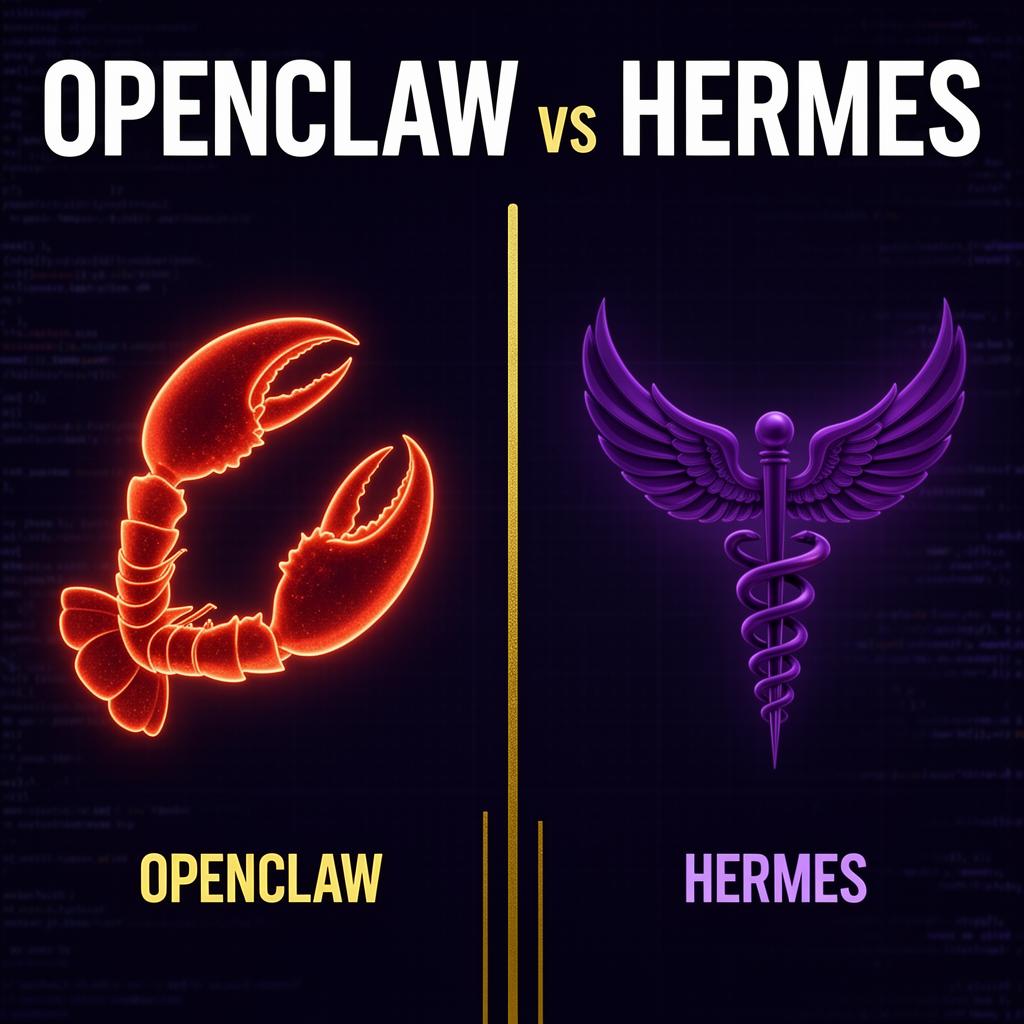
Architecture: claw vs. caduceus
OpenClaw is a TypeScript orchestration framework. You give it tools (file system, browser, code execution, plugins from its SDK), pick a model provider, and it runs multi-step workflows. The April Task Brain update layered an OS-style control plane on top — secrets management, a PDF tool, Telegram streaming, plugin sandboxing. Think of it as Kubernetes for agents: opinionated infrastructure, broad provider support, the ability to run on any OS or platform.
Hermes is a Python agent runtime with memory as a first-class primitive. It doesn't just call tools — it remembers which tool calls worked, generalizes them into reusable skills, and pulls the relevant skill back the next time a similar task appears. The "grows with you" tagline is literal: a Hermes instance running for 90 days is meaningfully more capable on your specific workload than a fresh install.
| | OpenClaw | Hermes Agent |
|---|---|---|
| Language | TypeScript | Python |
| Stars (Apr 2026) | ~359,000 | ~95,500 |
| Latest release | v2026.4.14 | v0.9.0 (v2026.4.13) |
| Core bet | Control plane + plugin ecosystem | Self-improving learning loop |
| Best at | Cross-platform automation, enterprise rollouts | Long-lived, personalized agents |
| License | Open source | MIT |
What's actually new this month
OpenClaw recent shipping:
Hermes recent shipping (v0.8 → v0.9):
Security: the one that almost broke OpenClaw
For most of 2025, OpenClaw's biggest knock was that it would do whatever you (or your prompt) asked. Researchers demonstrated trivial prompt-injection paths to file exfiltration. The Task Brain release in late March was a direct response — agents now operate under an explicit policy layer and can refuse. It's not a finished story, but it's a serious one.
Hermes took a different approach from the start: because the agent runs on your server with persistent memory, NousResearch leans on operator-controlled boundaries (filesystem scope, network ACLs, model-side guardrails) rather than an in-framework permission system. That's fine if you're a sophisticated operator. It's a footgun if you're not.
Which one should you deploy?
Pick OpenClaw if: you're a TypeScript shop, you want broad provider support, you need to deploy the same agent across Mac/Linux/Windows, and you value the largest plugin ecosystem in open-source agents right now. The Task Brain control plane makes it the safer pick for teams without a dedicated AI infrastructure engineer.
Pick Hermes if: you're Python-native, you have one or two specific, recurring workloads where an agent will pay back compounding learning over months, and you're comfortable owning the security boundary yourself. The learning loop is genuinely differentiated — no other open-source agent improves at your specific tasks the way Hermes does.
Pick neither if: you need an agent shipped, secured, and integrated into your real workflows in days instead of 14 weeks. That's the gap 88 Labs AI closes — production agents on your stack, your data, your KPIs. See your free demo →
The bigger signal
Two of the most-watched open-source agent projects on Earth shipped major releases on consecutive days in April 2026. That's not a coincidence — it's the agent layer maturing in public. Frameworks are real, the security conversation is real, and the question for businesses is no longer "can we build an agent?" but "what does our agent do on Monday morning?"
If you want help answering that, book a free strategy call or browse our pre-built agents.
Ready to see this in action?
Get a free, personalized demo of an AI agent built for YOUR business.
Get Your Free Demo