Hermes Agent vs OpenClaw: Why the Community Is Migrating in 2026
Hermes Agent v0.6–v0.9 introduced self-learning, durable memory, and a Web UI that runs on a $5 VPS. Here is why teams are leaving OpenClaw behind.
88 Labs AI
Editorial Team
The short version
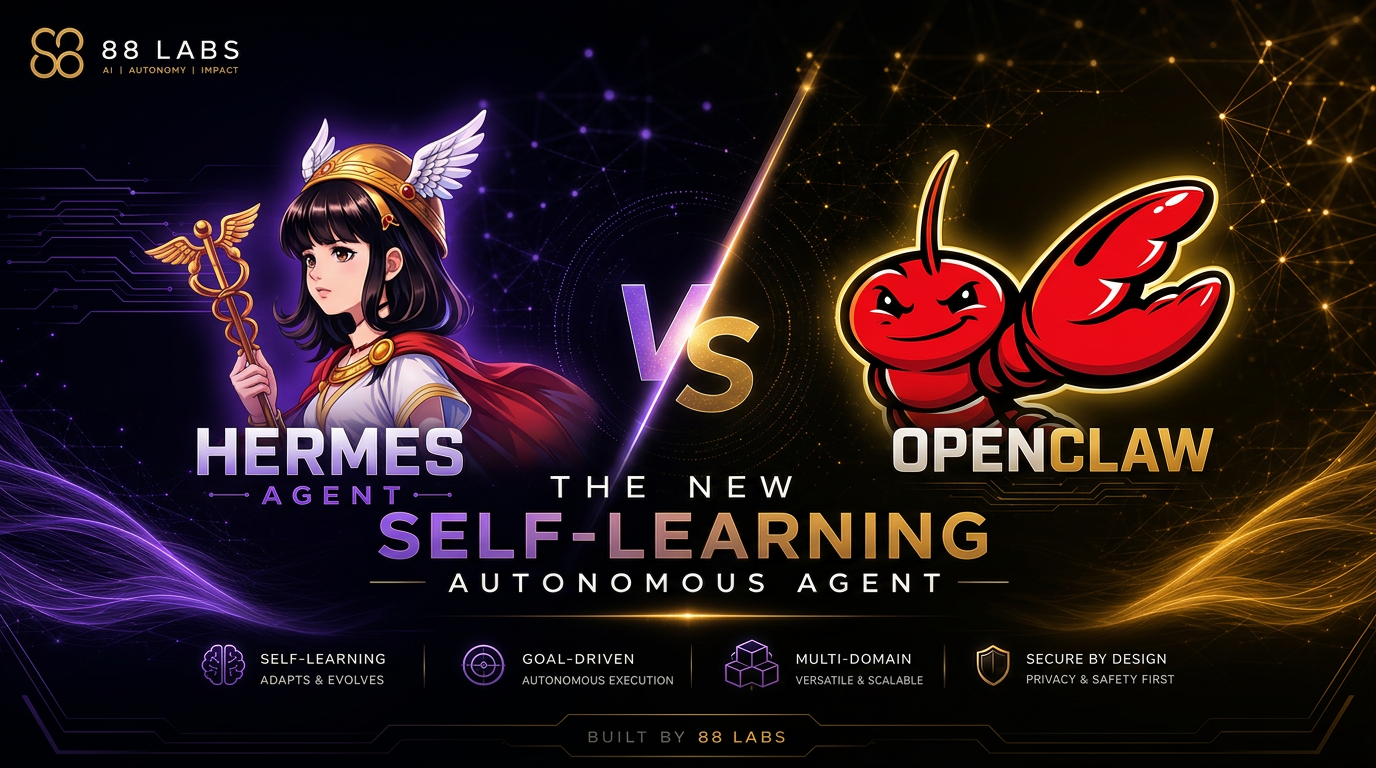
For most of 2025, OpenClaw was the default choice for anyone who wanted a local autonomous coding agent. That changed fast. Between v0.6.0 and v0.9.0, the Hermes Agent added a real self-learning loop, durable memory, a Web UI, a fast mode, and stability fixes that OpenClaw still has not matched.
The result: developers, researchers, and marketing teams are migrating in volume, and the conversation has shifted from "which one should I try?" to "why are you still on OpenClaw?".
What changed in Hermes v0.6 → v0.9
Where Hermes pulls ahead of OpenClaw
1. Scope: long-horizon work vs. local coding
OpenClaw was built around a tight inner loop: edit a file, run a test, repeat. That is excellent for narrow coding tasks and worse for anything that runs longer than a coffee break.
Hermes is designed for long-horizon autonomous tasks — research synthesis, marketing campaigns, recurring ops jobs, multi-day investigations — where the agent needs to remember what it learned yesterday and resume cleanly today.
2. Memory: real recall vs. memory degradation
OpenClaw users have been reporting memory degradation for months: the agent "forgets" earlier decisions, contradicts itself, or repeats work it already finished. Threads get unusable past a certain length.
Hermes uses a structured memory layer with explicit pin / recall / forget operations. Context survives across sessions, and the self-learning loop turns repeated solutions into named skills the agent can call by name.
3. Stability: consistent runs vs. update breakage
Several recent OpenClaw updates broke functionality that previously worked — connectors silently failing, jobs hanging, retries looping. Early Hermes 0.9 testing has been notably steadier: runs finish, errors surface clearly, and rollbacks are cheap.
4. Footprint: $5 VPS vs. heavy local install
Hermes is small enough to run on a $5/month VPS, which means you can leave it running 24/7 without burning your laptop battery. OpenClaw still expects a beefy local environment.
Watch the community take
Two videos are worth your time before deciding:
Both creators land on the same conclusion: OpenClaw was the pioneer, but Hermes is where the autonomy story is actually shipping in 2026.
When OpenClaw is still the right call
This is not a clean win on every axis. Stick with OpenClaw if:
For everything else — long-running agents, marketing automation, research, anything that needs memory across days — Hermes is now the safer bet.
How to evaluate Hermes in one afternoon
1. Spin up a $5 VPS (DigitalOcean, Hetzner, or similar).
2. Install Hermes 0.9 and enable the Web UI.
3. Run a real task you have already done in OpenClaw — same prompt, same data.
4. Compare three things: time to finish, memory fidelity at turn 30+, and how many manual rescues you had to do.
5. Turn on fast mode and re-run. Note the cost difference.
If Hermes finishes the job with fewer rescues and remembers what it did, you have your answer.
Bottom line
OpenClaw earned its place as the local-agent pioneer. Hermes 0.6 → 0.9 is the first release cycle where a competing open agent is measurably more autonomous, more stable, and cheaper to run for the kind of long-horizon work most teams actually care about.
If you are deploying agents in production in 2026 — for clients, for marketing, for research — Hermes deserves a serious afternoon of your time this week.
Ready to see this in action?
Get a free, personalized demo of an AI agent built for YOUR business.
Get Your Free Demo