Hermes Agent v0.14.0 "The Foundation Release": Grok 4.3, LSP Diagnostics, and a Lean Install
NousResearch ships Hermes Agent v0.14.0 with xAI Grok integration, an OpenAI-compatible local proxy, X/Twitter search, full Microsoft Teams wiring, on-write LSP semantic diagnostics, and aggressive debloating. Here is what is new and why it matters.
88 Labs AI
Editorial Team
What v0.14.0 actually is
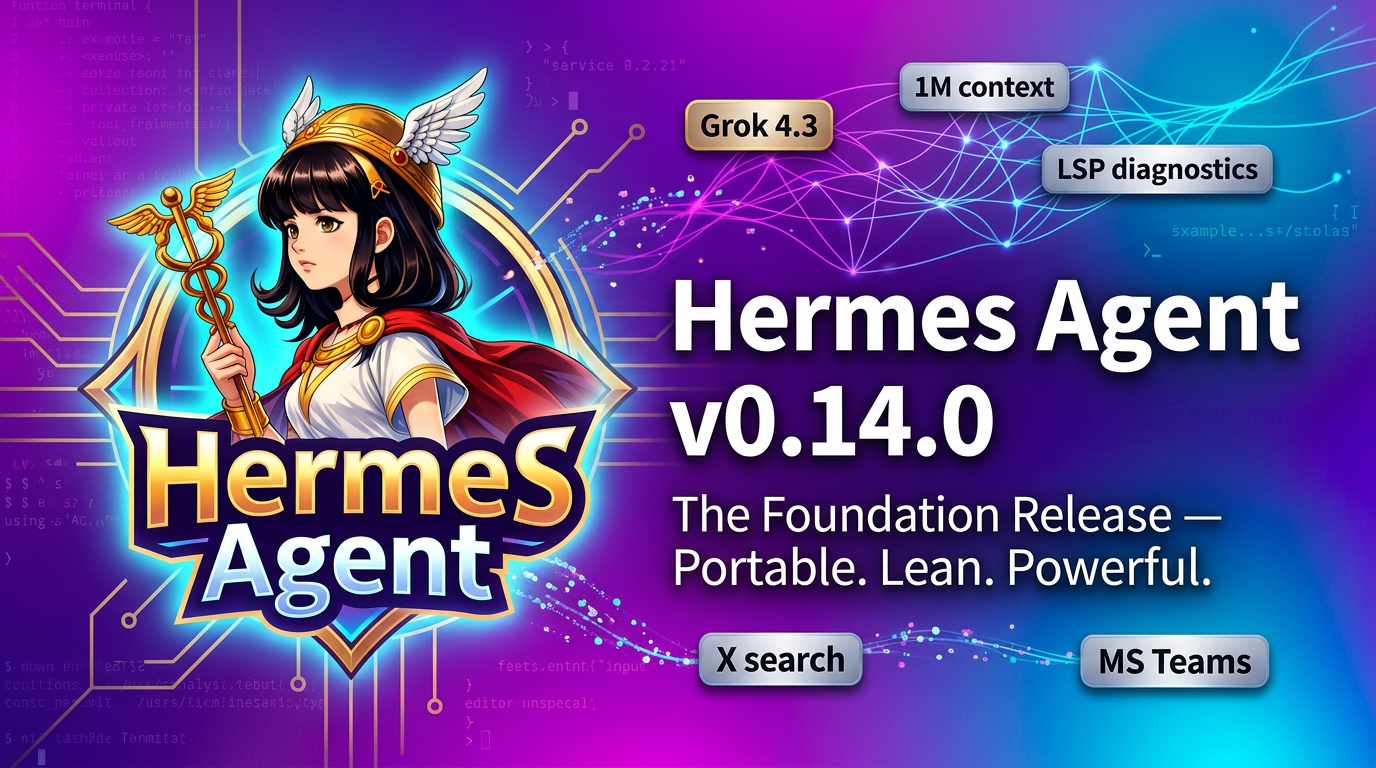
NousResearch just dropped Hermes Agent v0.14.0, nicknamed "The Foundation Release" (May 16, 2026). The headline theme is two words: portability and bloat reduction. Hermes now installs anywhere and ships only the pieces you actually use — heavyweight backends lazy-install on first invocation instead of bloating the base image.
For teams running production agent stacks, this is the kind of release that quietly fixes a dozen complaints at once: lighter Docker images, faster CI, fewer transitive dependency conflicts, and a much shorter cold start on serverless deploys.
1. Grok lands as a first-class provider
xAI SuperGrok is now an OAuth provider inside Hermes, with `grok-4.3` at a 1M-token context window. That means you can swap Hermes between Claude, GPT-5, Gemini 3, and Grok 4.3 with a one-line config change — no API key plumbing, no third-party gateway.
For long-context workloads — repo-wide refactors, multi-document research, hour-long meeting transcripts — Grok 4.3 at 1M context is now the cheapest seat at the table if you already pay for SuperGrok.
2. The OpenAI-compatible local proxy is the sleeper feature
This is the change most teams will quietly fall in love with. Hermes v0.14 ships a local proxy that turns any OAuth-authed provider — Claude Pro, ChatGPT Pro, SuperGrok — into a standard OpenAI-compatible endpoint running on `localhost`.
Which means tools that only speak the OpenAI API — Codex, Aider, Cline, Continue — can now hit your Claude Pro or SuperGrok subscription directly, with no extra API spend.
Practical translation: one $20/mo Claude Pro seat can power your entire local IDE stack. That is a real budget line item for indie devs and small teams.
3. x_search becomes a first-class tool
Hermes now has a built-in `x_search` tool with OAuth or API-key auth against X/Twitter. Agents can pull live posts, search threads, and pipe results straight into reasoning — no scraping, no headless browser.
Use cases that just got easy:
4. Microsoft Teams: full end-to-end wiring
Graph auth plus webhooks are now fully wired. Hermes can authenticate as a Teams app, post into channels, respond to mentions, and trigger flows from inbound messages.
For enterprises that live in Teams (read: most of them), this closes the last gap that made Hermes feel like a "Slack-first" agent.
5. LSP semantic diagnostics on every write
v0.13 had basic linting. v0.14 runs an actual language server after every `write_file` or `patch` call and feeds type errors, undefined symbols, and missing imports back to the agent before the next turn.
This matters more than it sounds. The single biggest source of agent thrash on coding tasks is "fix one thing, break two others, fix those, break one more." LSP-in-the-loop collapses that cycle by forcing the model to see compiler-grade feedback immediately instead of waiting for a test run or a human to catch it.
In practice: fewer turns per task, fewer broken commits, more agent-written PRs that actually merge.
6. Debloating: lazy-install heavyweight backends
Heavyweight backends (vision models, audio pipelines, headless browsers, vector DB clients) now install on first use instead of at base install. The default Hermes install is dramatically smaller.
Why you care:
Should you upgrade?
If you are already on Hermes 0.13.x: yes, immediately. The LSP-in-the-loop diagnostics alone are worth the upgrade for any coding-agent workflow, and the lazy-install change is a free win on image size.
If you are evaluating agent frameworks for the first time: v0.14 is the cleanest entry point Hermes has ever had. Lighter install, more providers, real Teams support, and a local proxy that quietly makes your existing AI subscriptions go further.
The theme — foundation — is the right name. Nothing here is flashy. Everything here makes the next twelve months of building easier.
Ready to see this in action?
Get a free, personalized demo of an AI agent built for YOUR business.
Get Your Free Demo